








‘Surely there cannot be a finer itinerary for a long-distance walk! … The countryside traversed is beautiful almost everywhere, yet extremely varied in character, with mountains and hills, valleys and rivers, heather moors and sea-cliffs combining in a pageant of colourful scenery.’ A. Wainwright A Coast to Coast Walk pp. v & vi
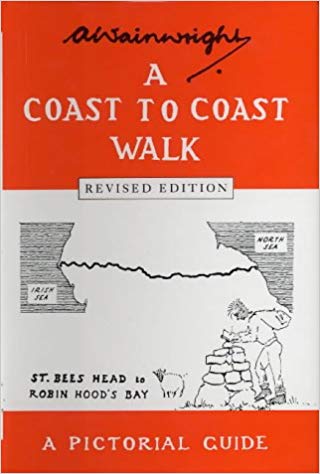
A Coast to Coast Walk was devised by Alfred Wainwright, and his guidebook to the route was published in 1973. Wainwright suggested a way of breaking the walk miles into stages, each of which to be completed in a day. With one or two rest days, this enables the route to fit into a two-week holiday. However, Wainwright stated that people walking the Coast to Coast should not feel constrained to keep to these day-stages or even to his route: for example, by reducing the days to 10 or 12 miles, the walk becomes more leisurely with time to stand and stare.
A Second Edition of A Coast to Coast Walk was published in June 2010 by Frances Lincoln. The book was completely revised and updated by Chris Jesty and is kept updated with the assistance of the Society.
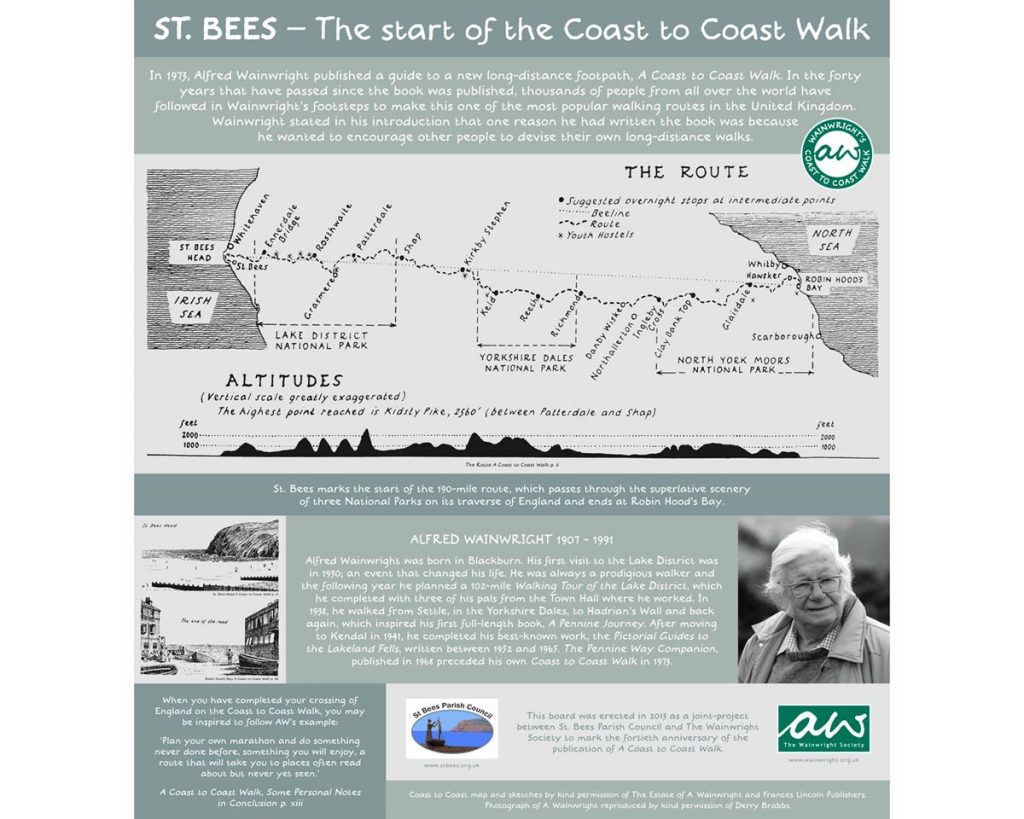
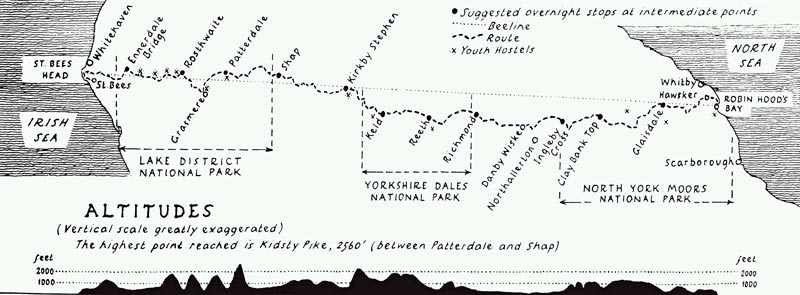
The Route. A Coast to Coast Walk, pp. i & ii

In 2012, the Society was named as the Responsible Organisation for the Coast to Coast and now publicises the walk on its website and reports access issues on the route. The same year, the Society announced that a new waymarker, featuring Wainwright’s AW signature, would appear on finger posts where the route crosses a public road. The task of placing the markers was completed by local authority access officers on most of the route during 2013.
The costs of providing the waymarkers was covered by our 2013 fundraising and as well as waymarking the route, new information boards were installed at St. Bees and Robin Hood’s Bay designed and funded by the Society. The balance of our fundraising that year was donated to the various Mountain Rescue Teams who cover the route and help keep walkers safe on their journeys across the country.

A Coast to Coast Walk, Frontispiece

A Coast to Coast Walk, p. 163

Unveiling the Information Board at St. Bees where most people start the walk

Unveiling the Information Board at Robin Hood’s Bay, normally the end of the walk
The Coast to Coast Route – We need your help! The Coast to Coast Walk is enjoyed by thousands of walkers each year. It is one of the most popular long-distance walks in the U.K. The walk is generally well signposted but over time access problems can arise or the route can be obstructed by, for example, blocked paths or overgrown hedges. The Society keeps in touch with the responsible local authorities along the route with the intention of making the walk as trouble free as possible. However, we can’t do this without the help of people who walk the route.
If you are planning to walk the Coast to Coast we would be really grateful for your help in flagging up any route problems you come across during the course of your walk. If you are happy to do this please download the form below, complete it as appropriate, and return it via email or post to the address at the foot of the form. If you can also illustrate the problem with a digital photograph that would be a great help. We hope your walk will be trouble free but thanks in advance for any help you can give. It is much appreciated.
To download a printable PDF of the form Click Here
The Society maintains a Coast to Coast Completers register and has Completers certificates available for purchase. Details can be found on the Completers Section.